HOME
BOOK STATUS
Suitings
Jacketing
Trousers
Formal Festive
Linings
Shirtings & Coatings
Alashan
Alazar
Bedlam
Carlo Barbera
Chelsea IV
Classics II
Crown Classic
Flannel
Flannels & Covert
Flex Sport
Fresco
Genesis
Greenhills
Irish Linen
Legacy
Mercury
Quest Cotton
QX & QZ fabrics
Revenge
Seersucker
Sunny Season Classics
Worsted Alsport
Jacketing
Alashan
Alsport
Bamboo III
Carlo Barbera Jacketings
Harris Tweed
Portofino
Pure Cashmere
Snowflake Clear
Snowflake Milled
Solid Textured Jacketing
Twister
Worsted Alsport II
Trousers
Formal Festive
Linings
Shirtings & Coatings
HOME
COLLECTIONS
Alazar
(Volume: 428-E)
Alazar IX
(Volume: 497)
Alazar VIII
(Volume: 489-E)
Alazar X
(Volume: 511)
Alazar XI
(Volume: 527)
Alazar XII
(Volume: 535)
Alazar XIII
(Volume: 613)
Alsport II
(Volume: 581)
Andiamo Knits
(Volume: 567)
Andiamo Knits II
(Volume: F612)
Andiamo Suits
(Volume: 566)
Bamboo
(Volume: 491-E)
Bamboo - The Next Generation
(Volume: 621)
Bamboo Ensembles
(Volume: 671)
Bamboo II
(Volume: 533)
Bamboo III
(Volume: 601)
Bamboo IV
(Volume: 657)
Bash
(Volume: 666)
Bash
(Volume: 483)
Bash II
(Volume: 600)
Bedlam
(Volume: 461-E)
Bedlam II
(Volume: 629)
Best of VBC
(Volume: 660)
Best of Vitale Barberis Canonico
(Volume: 645)
Black Tie
(Volume: 484)
Blasone II
(Volume: 468-E)
Revenge
(Volume: 386-E)
Revenge II
(Volume: 426-E)
Revenge IX
(Volume: 626)
Revenge VII
(Volume: 496)
Revenge VIII
(Volume: 564)
Borealis
(Volume: 688)
Legacy 8
(Volume: 512)
Legacy 9
(Volume: 563)
Legacy VII
(Volume: 481)
LegacyVI
(Volume: 457-E)
Carlo Barbera
(Volume: 625)
Carlo Barbera
(Volume: 611)
Carlo Barbera II
(Volume: 537)
Carlo Barbera By Colour
(Volume: 592)
Carlo Barbera Jacketings
(Volume: 530)
Carlo Barbera Jacketings
(Volume: 569)
Carlo Barbera Jacketings
(Volume: 552)
Carlo Barbera Suiting
(Volume: 529)
Carlo Barbera Suitings
(Volume: 551)
Cashmere
(Volume: 627)
Casual Irish Linen
(Volume: 616)
Chelsea V
(Volume: 634)
Chelsea IV
(Volume: 602)
Classic II
(Volume: 477-E)
Coleridge
(Volume: 476)
Comfort Zone
(Volume: 594)
Comfort Zone Stretch Cotton
(Volume: 631)
Como Ensembles
(Volume: 670)
Cotspire IV
(Volume: 076)
Covert Lite
(Volume: F615)
Crown Classic
(Volume: 580)
Dorchester Lambswool
(Volume: 639)
English Coatings
(Volume: 357-E)
Enterprise
(Volume: 618)
Eskdale Trousers
(Volume: 429-E)
Excelsior 150s
(Volume: 366-E)
Exclusive Limited Sports Jackets
(Volume: 622)
Flannels
(Volume: 470-E)
Flannels & Coverts
(Volume: 532)
250th Commemorative Linings
Flash Linings
(Volume: 669)
Flash Vol. 2
(Volume: 502)
Flash Vol. 3
(Volume: 545)
Flash Vol. 4
(Volume: 603)
Flash Vol. 5
(Volume: 638)
Flash!
(Volume: 475-E)
Flex Cotton
(Volume: 531)
Flex II - Stretch Wool & Cotton
(Volume: 648)
Flex Sport
(Volume: 549)
Fresco
(Volume: 574)
Fresco Lite
(Volume: 680)
Fresco Lite Elements
(Volume: 682)
Fresco Lite Twisted
(Volume: 681)
Fresco Mock Leno
(Volume: 640)
Genesis
(Volume: 495-E)
Graffiti and Stretch Covert
(Volume: 687)
Harris Tweed
(Volume: 471-E)
Harris Tweed (Volume II)
(Volume: 654)
Heritage
(Volume: 677)
Irish Linen / Seersucker / Quest Cotton
(Volume: 506)
Italian Coatings
(Volume: 544)
Kodiak
(Volume: 656E)
Kodiak
(Volume: 656)
Liberty Linings
(Volume: 650)
Linings
(Volume: 393)
Linings II
(Volume: 453-E)
Lodestar
(Volume: 649)
Mercury 3
(Volume: 523)
Mozzare Harness Linens
(Volume: 690)
Offers
(Volume: None)
Phantom Flannel
(Volume: 653)
Polo Stretch
(Volume: 586)
Polo Stretch II
(Volume: 593)
Portofino IX
(Volume: 505)
Portofino VII
(Volume: 490-E)
Portofino VIII
(Volume: 504)
Portofino X
(Volume: 528)
Portofino XI
(Volume: 548)
Portofino XII
(Volume: 643)
Portofino XIII
(Volume: 651)
Precious Fibers
(Volume: 628)
Q Project - QX
(Volume: 412-E)
Q Project - QZ
(Volume: 411-E)
Quest Cottons 2
(Volume: 553-E)
QX2
(Volume: 494)
QZ2
(Volume: 508)
Reflex
(Volume: 667)
Reflex - Voyager
(Volume: 667)
Rugby Linens V689
(Volume: 689)
Rugby Shirting
(Volume: 083)
Rugby Tropical
(Volume: 652)
Safari
(Volume: 668)
Safari
(Volume: 562)
Saratelle
(Volume: 422)
Snowflake
(Volume: 623)
Snowflake
(Volume: 624)
Snowflake IX
(Volume: 499)
Snowflake VI
(Volume: 485-E)
Snowflake VII
(Volume: 486-E)
Snowflake VIII
(Volume: 498)
Snowflake X
(Volume: 509)
Snowflake XI
(Volume: 510)
Snowflake XII
(Volume: 536)
Snowflake XIII
(Volume: 568)
Snowflake XIV
(Volume: 614)
Solid Textured Jacketing
(Volume: 550)
Sprezzatura Dress Shirting Fabrics
(Volume: 521)
Sprezzatura Sport Shirting Fabrics
(Volume: 522)
Spry
(Volume: 620)
Summer Breeze
(Volume: 617)
Sunny Season
(Volume: 534)
Sunny Season Classics III
(Volume: 534)
Sunny Seasons
(Volume: 493)
Super Black
(Volume: 642)
Super Gabardine
(Volume: 554)
Super Solids
(Volume: 143F)
Super Solids II
(Volume: 525F)
Textured Jackets
(Volume: 644)
Twister
(Volume: 410-E)
Voyager
(Volume: 630, 632, 667)
Voyager II
(Volume: 637, 637E)
Winter Classics II
(Volume: 482-E)
Woolen Flannel
(Volume: 678)
Worsted Alsport II
(Volume: 458-E)
GARMENT TYPE
Suitings
Alashan
Alazar
Bedlam
Carlo Barbera
Chelsea IV
Classics II
Crown Classic
Flannel
Flannels & Covert
Flex Sport
Fresco
Genesis
Greenhills
Irish Linen
Legacy
Mercury
Quest Cotton
QX & QZ fabrics
Revenge
Seersucker
Sunny Season Classics
Worsted Alsport
Jacketing Alashan Alsport Bamboo III Carlo Barbera Jacketings Harris Tweed Portofino Pure Cashmere Snowflake Clear Snowflake Milled Solid Textured Jacketing Twister Worsted Alsport II
Trousers Blasone Eskdale Super Gabardine
Formal Festive Bash! Black Tie Saratelle
Linings Flash! Inside Story
Shirtings & Coatings English Coatings Italian Coatings Mojo Sprezzatura Dress Shirting Sprezzatura Sport Shirting
BOOK STATUS
GLADSON INSIGHTS
LOOK BOOKS
NEWS & EVENTS
Jacketing Alashan Alsport Bamboo III Carlo Barbera Jacketings Harris Tweed Portofino Pure Cashmere Snowflake Clear Snowflake Milled Solid Textured Jacketing Twister Worsted Alsport II
Trousers Blasone Eskdale Super Gabardine
Formal Festive Bash! Black Tie Saratelle
Linings Flash! Inside Story
Shirtings & Coatings English Coatings Italian Coatings Mojo Sprezzatura Dress Shirting Sprezzatura Sport Shirting
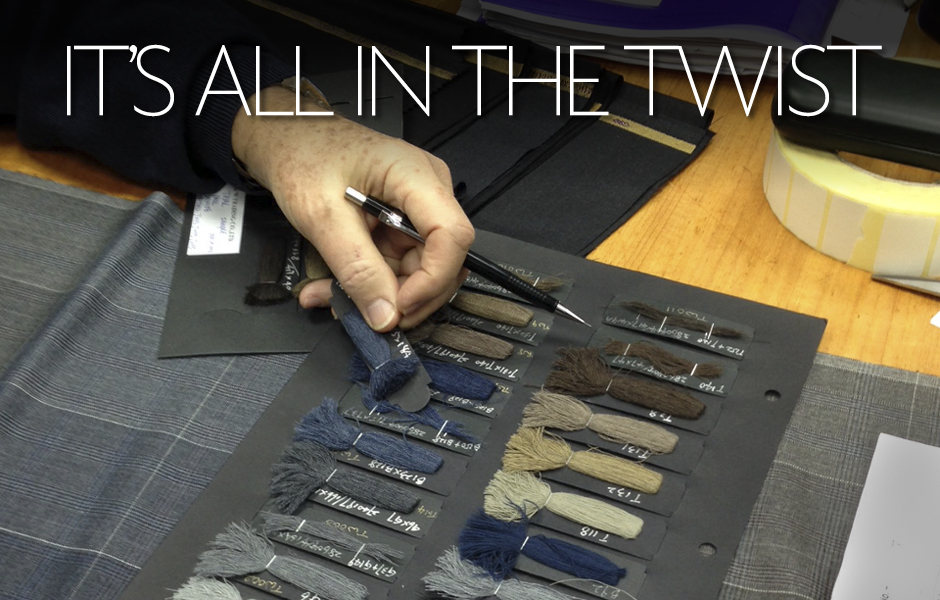
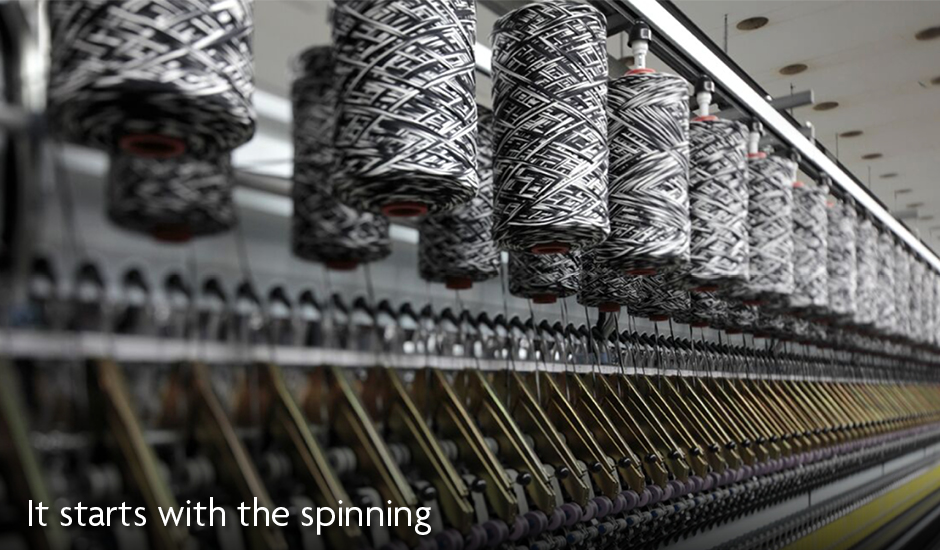
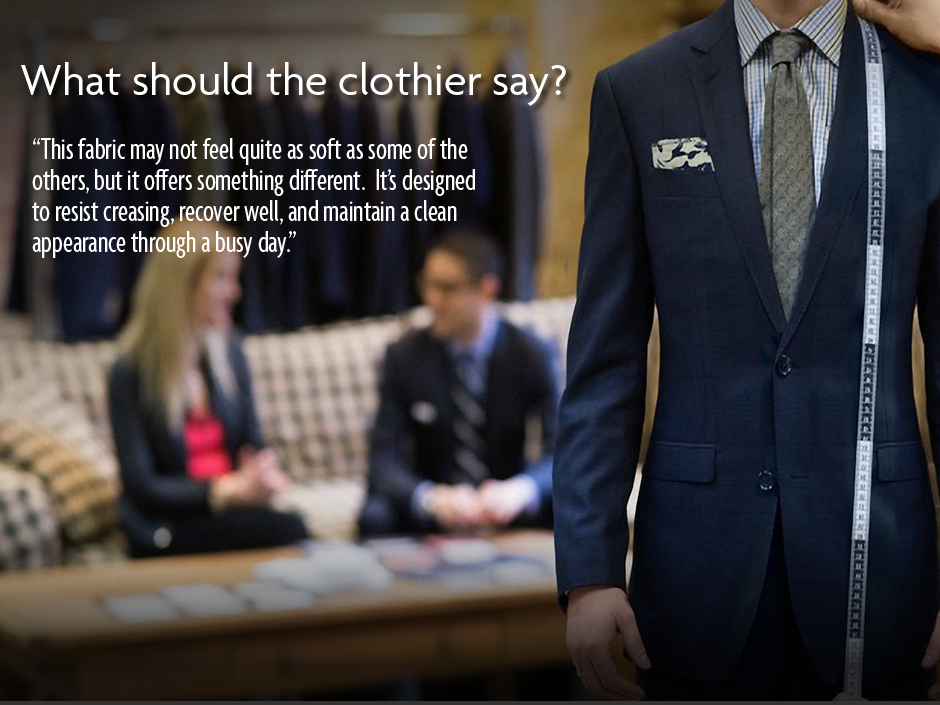
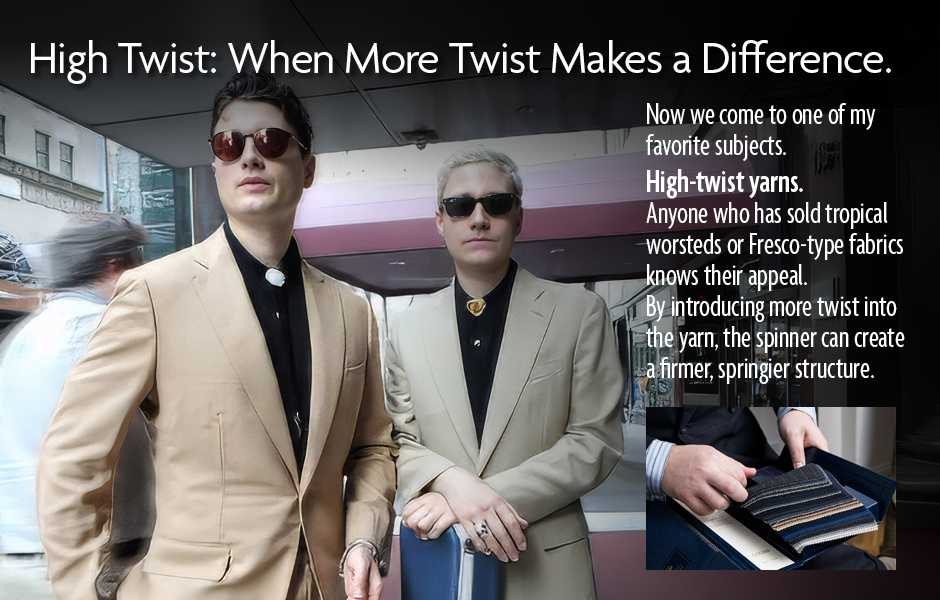 When combined with an appropriate weave and finishing, these yarns can produce fabrics with excellent crease recovery, a crisp hand, and the ability to maintain a neat appearance throughout the day.
Consider the businessman who travels frequently.
He sits on an airplane for several hours, gets into a car, attends meetings, and perhaps finishes the day at dinner.
He wants to look reasonably fresh without carrying a portable pressing machine.